Advanced Materials
What Is Boron Carbide (B₄C) and Why Is It Shaping the Future of Advanced Materials?
Ergun Tarkan Cakir
Throughout my career, I have worked across manufacturing, enterprise software, cybersecurity, critical infrastructure, and defense-related technologies. One lesson has consistently emerged regardless of industry: breakthrough capabilities are rarely driven by software alone. More often, they begin with advances in the materials that enable entirely new levels of performance.
Today, one of the most important transformations occurring across defense, aerospace, energy, mobility, and advanced manufacturing is the growing importance of advanced materials. As engineering systems become lighter, smarter, and more performance-driven, materials increasingly define what is possible.
Among these advanced materials, Boron Carbide (B₄C) occupies a unique position.
Understanding Boron Carbide
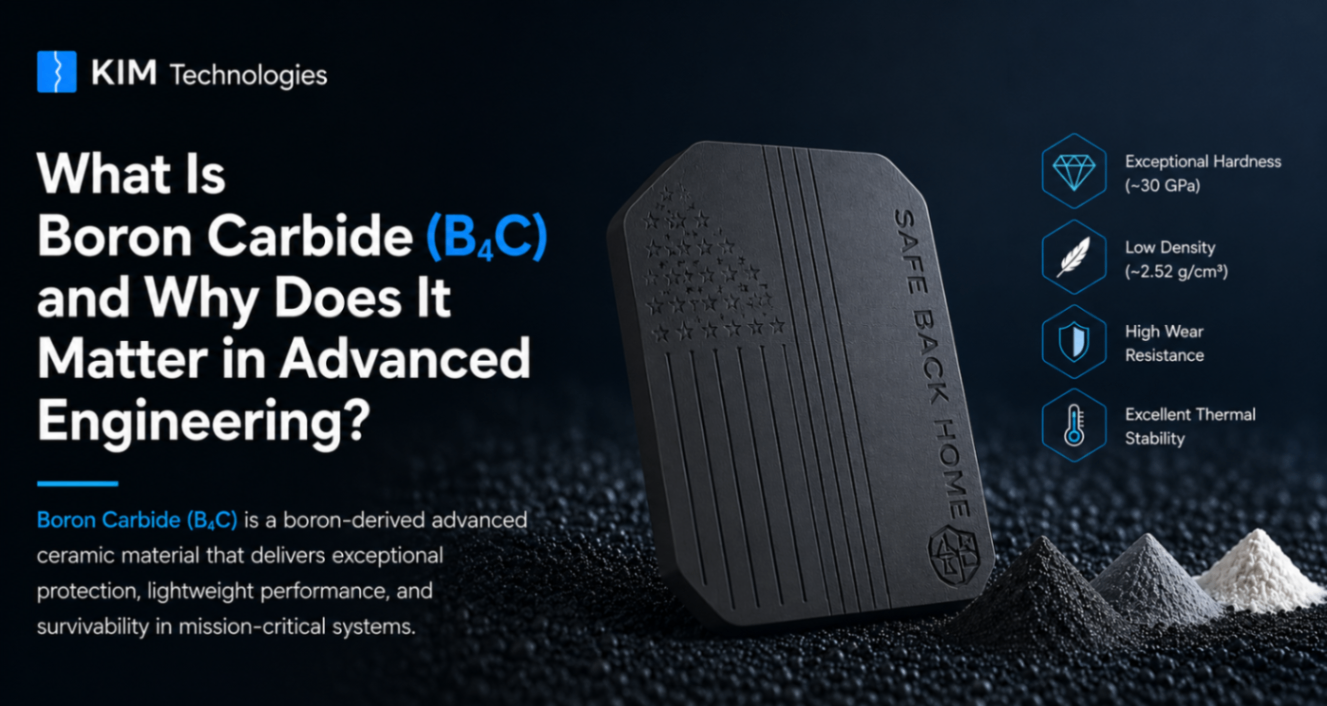
Boron Carbide is an advanced ceramic material produced through high-temperature reactions involving boron-rich compounds and carbon. It is widely recognized as one of the hardest engineered materials available for industrial use.
However, its significance extends far beyond hardness.
What makes Boron Carbide strategically important is its ability to combine multiple performance characteristics within a single material system:
- Exceptional hardness
- Low density
- High wear resistance
- Thermal stability
- Structural efficiency
In many engineering applications, these characteristics allow designers to reduce weight without compromising durability, protection, or operational performance.
As industries continue to pursue higher performance with lower mass, Boron Carbide has become increasingly relevant across a growing range of applications.
Why Weight Matters More Than Ever
Historically, engineering performance was often measured by strength alone. Today, that equation has changed.
Modern systems must balance:
- Performance
- Mobility
- Efficiency
- Survivability
- Lifecycle cost
- Operational flexibility
Weight influences each of these factors.
Reducing system weight can improve vehicle range, increase payload capacity, enhance mobility, reduce energy consumption, and improve human performance in demanding operational environments.
This reality explains why lightweight materials are becoming central to future engineering strategies.
Whether in aerospace platforms, unmanned systems, mobility solutions, industrial equipment, or personal protection technologies, every kilogram saved creates opportunities for improved performance.
The Evolution of Survivability Engineering
One of the most interesting developments in recent years has been the evolution of survivability engineering.
Protection systems were once designed primarily around stopping threats. Today, survivability has become a far more sophisticated discipline.
Engineers increasingly evaluate systems based on:
- Protection effectiveness
- Weight optimization
- Damage tolerance
- Operational endurance
- Mission continuity
This shift has increased interest in advanced ceramic materials such as Boron Carbide.
Its unique combination of hardness and lightweight performance makes it particularly valuable in applications where both protection and mobility are critical.
Yet material selection alone is not enough.
Materials Are Only Part of the Solution
One of the most common misconceptions in advanced protection technologies is the belief that performance depends entirely on material properties.
In reality, system architecture often matters just as much as the material itself.
Modern engineering increasingly combines advanced materials with sophisticated structural concepts designed to manage:
- Energy distribution
- Crack propagation
- Localized damage
- Residual structural integrity
Future breakthroughs will likely emerge not from materials alone, but from the integration of material science, manufacturing technologies, computational modeling, and architecture-driven design.
The most successful engineering ecosystems will be those capable of combining all of these disciplines into unified solutions.
Beyond Protection Systems
Although Boron Carbide is frequently associated with protection technologies, its importance extends well beyond armor-related applications.
Today, B₄C contributes to a variety of high-performance industries, including:
Aerospace
Lightweight structures and specialized components where mass reduction directly influences performance.
Energy and Nuclear Systems
Applications requiring neutron absorption, shielding, and long-term environmental stability.
Industrial Manufacturing
Wear-resistant components operating in highly demanding environments.
Advanced Mobility Platforms
Systems where durability, efficiency, and lightweight performance must coexist.
As global industries continue to pursue higher efficiency and lower weight, the relevance of advanced ceramics will continue to grow.
Building the Ecosystems Behind Advanced Materials
The future of advanced materials is not determined solely by chemistry.
Successful deployment requires complete engineering ecosystems capable of integrating:
- Raw material expertise
- Powder processing technologies
- Advanced manufacturing
- Sintering science
- Mechanical testing
- Characterization technologies
- Quality assurance systems
Organizations capable of connecting these capabilities into scalable industrial platforms will play a significant role in shaping future technologies.
In many ways, the next generation of innovation may depend less on discovering entirely new materials and more on improving our ability to design, manufacture, and integrate the materials we already know possess extraordinary potential.
Looking Forward
Boron Carbide is no longer simply a high-hardness ceramic material.
It is becoming part of a broader advanced materials ecosystem that supports the future of aerospace, mobility, manufacturing, energy, and defense technologies.
As engineering challenges continue to evolve, advanced ceramics such as Boron Carbide will remain essential to the development of lighter, stronger, and more capable systems.
The future of innovation will not be built by software, electronics, or manufacturing alone. It will increasingly be shaped by the materials that enable them all.
Contact
Open to Strategic Dialogue.
Available for industry collaboration, advisory engagements, speaking invitations, and professional inquiries.
Send an Inquiry